
What Every Fleet Should Know Before Hiring an Outsourcing Partner
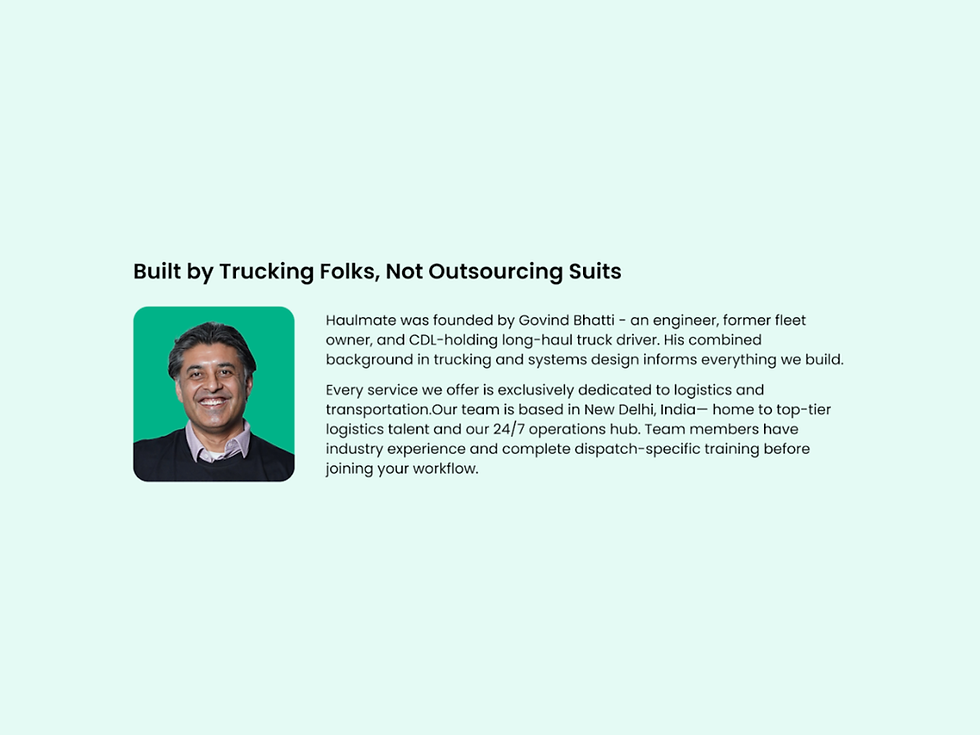
By Govind Bhatti, Founder & CEO of Haulmate
I talk to a lot of brokers and carriers who've been let down by outsourcing partners that did not deliver the dispatching operations they promised.
A broker in North Carolina told me he signed with a company that oversold him by five staffers when he needed maybe two. They’re not even properly trained, and he's locked into a one-year, no-cancel contract. Another fleet I know paid to train eight people staffed from a different provider, only to discover there's no transition plan for when someone leaves. They're getting less than 50% of the value they were promised.
These aren't isolated stories. They're becoming the norm in our industry. And frankly, it's making logistics companies rightfully skeptical altogether about outsourcing their operations.
But here's the thing: outsourcing done right can transform your operation. The problem isn't outsourcing itself. It's that most companies don't know what questions to ask before they sign on the dotted line.
So, let me walk you through what you really need to know.
Start with the Right Questions
When I first speak with a potential client, I ask them about their current outsourcing experience. If they are collaborating with an outsourcing firm, I want to know: How long does it take your provider to fill a new role? What's the expertise level of the people they're sending you? Are these workers trained in logistics, or are you doing all the training yourself?
And here's the big one: What happens when someone quits? Because in this industry, turnover happens. If your outsourcing partner makes you start the entire training process over every time someone leaves, you're not really outsourcing. You're just hiring remotely with extra steps.
You should also ask about contracts. A year-long commitment with no way out? That's a red flag. If a provider is confident in their service, they'll let you start small and prove the value first.
The Training Problem Nobody Talks About
Here's what I've learned after almost eight years in this business: English proficiency isn't enough. Working in logistics isn't for everyone. You can have someone who speaks perfect English, but if they don't understand what a check call is or can't read a bill of lading, they'll need months of training before they can be productive.
Most outsourcing companies hire generally capable people-- and then expect you to teach them logistics from scratch. That's backwards.
At Haulmate, we built something different. We operate a sister firm, Bridge18, which essentially is our farm team. It's a working operation that provides fractional back-office operations services to smaller trucking companies with everything from load bookings and track and trace to document verification, billing, and payment follow-up. Every Haulmate hire works on the Bridge18 team first, building experience in a live trucking environment.
They learn the entire lifecycle of a load. They handle data entry. They monitor schedules to ensure trucks are good for on-time pickup and deliveries. They verify bills of lading and temperature readings. They make check calls. They manage more complex scenarios like truck breakdowns and delayed deliveries.
By the time we place them as a Haulmate staffer with an outsourcing client, they already know logistics. You don't have to train them on the basics. If you ask them what a check call is, they know exactly what you're talking about. All they need to learn is your specific operational systems, your reporting structure, and your escalation workflows. That's it.
When I lay this out to prospects, it gets their attention. Because they realize they're not getting a generalist who happens to work remotely. They're getting someone who's already been doing the job they are taking on.
The India Advantage You Haven't Considered
I source talent from India. India has the second-largest English-speaking population in the world. The business-processing outsourcing industry has been established there for decades. Yes, handling U.S. logistics from there is relatively new, but the infrastructure and talent pool to draw from for this kind of work is deep and the talent is accustomed to working US hours. Some competitors talk about "nearshore" options as if they're inherently better.
But here's the reality: if someone is outside the country, they're outside the country. All that matters is 24/7 availability. Location outside of the US doesn't change the fundamental nature of remote work. What’s important is the level of training, communication, and accountability that each outsourcing provider delivers.
It’s about how well the work gets done!
How Haulmate Onboards
We start with a questionnaire about the role, the duties, the tools, and the reporting structure for the prospect’s operations. Then, we assign a senior team member to lead from day one.
Our onboarding is highly collaborative— we align on workflows, build clear SOPs, and integrate directly into the client’s operation. When you're working with remote staff, you can't assume anything. We emphasize structured communication, clear accountability, and real-time visibility into workload and performance, while maintaining a continuous feedback loop both ways to address gaps, improve processes, and ensure consistent results. We want to get it right from day one— there is no such thing as overcommunicating!
With strong leadership alignment and dedication to success, our team ramps up quickly and begins contributing in a short period of time.
Start with One
I don't oversell. I tell prospects to start with one person and see how it goes. If it works out, great. If it doesn't, it doesn't. I'm not interested in locking anyone into a contract for multiple people before they've even seen results.
Recently, one of our clients, a large nationwide carrier of primarily temperature-controlled freight, told us that a customer mentioned one of our Haulmate team members by name. Talk about word of mouth. They said his communication has been fabulous, with a response time of less than five minutes. And in 100 days, they haven't had a single email go unanswered. That's the level of service we're aiming for - and this is just one example.
It only happens through training, execution, and demanding accountability!
If you're considering outsourcing dispatch operations, don't swing at the first pitch you hear. Ask the hard questions. Make sure you're not locked into an arrangement that doesn't serve you. And make sure you're working with a company that understands the logistics business and the purpose and importance of each task. Trust me, I’ve lived it— I started as an over-the-road truck driver and that has informed everything we do at Haulmate!
Because at the end of the day, it’s all about successfully moving your freight.



Comments