
2026 Motor Freight Outlook: A Foundational Year of Gradual Gains
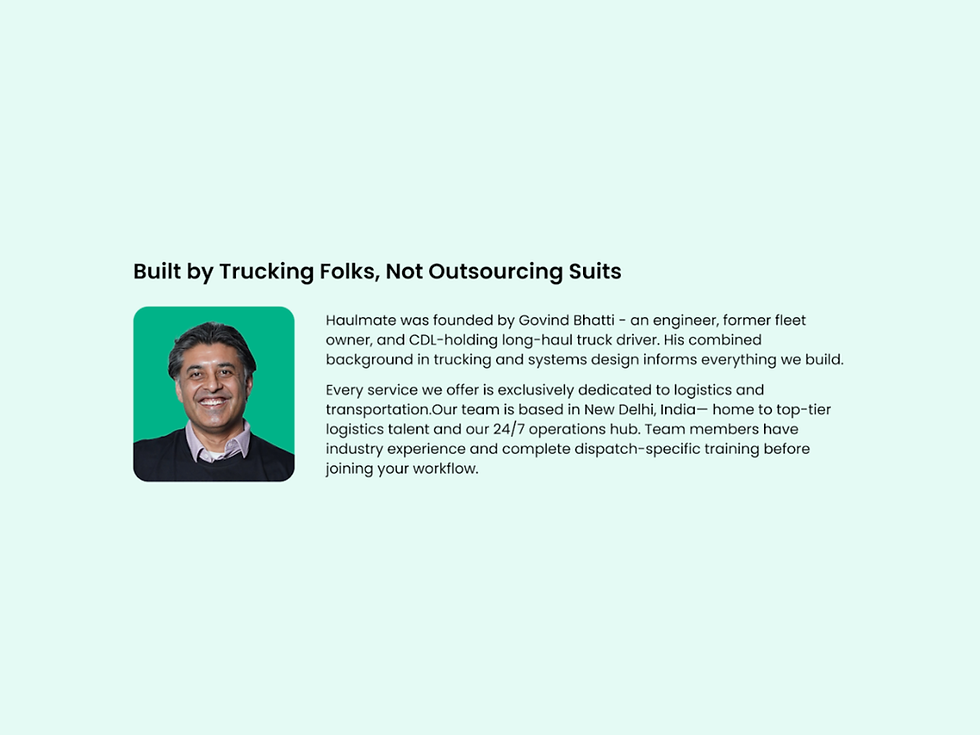
By Govind Bhatti, Founder & CEO of Haulmate
In 2026, freight transportation executives will again face challenging market conditions. There’s a lot to digest, including ongoing negative economic impacts from heavy tariffs and stubborn inflation, which currently stands at 2.7%; new and unexpected changes in key federal and state regulatory actions; adoption of AI logistics tools, and the continuing shortage of truck drivers and key operational personnel.
On the other hand, after enduring three brutal years of freight recession, North America's largest truckload carriers closed 2025 cautiously optimistic that in 2026, heightened enforcement of certain federal regulations, further capacity attrition, and disciplined operations may finally tilt market dynamics in their favor.
Analysis of Q3 2025 earnings calls held by J.B. Hunt and Knight-Swift
Transportation suggests these leading carriers expect a structural recovery in 2026 driven by supply-side contraction rather than by a rebound in demand.
Drawing on expertise from industry analysts presents a wide view of the year ahead. Ryder Systems reports that logistics trends to watch in 2026 include shifts in freight, warehousing, and labor impacts. Expect a greater emphasis on “practical, high-impact improvements across supply chain operations,” from transportation and warehousing to technology and partner strategy.
The 3PL and vehicle lease/maintenance giant sees “signs of steady momentum in supply chains” this year. While demand last year fell across several sectors, including in consumer discretionary categories, Ryder says activity in essential goods and B2B channels held steady, and commercial construction activity strengthened.
Ryder’s key factors to help build stronger logistics operations in 2026, include considering that:
· Networks will need to be shorter and more flexible, and supply chain visibility tools will become essential.
· Automation, AI, and regionalized networks will be “major drivers of resilience and speed” this year.
· Strong 3PL partnerships will be key for flexibility, scalability, and fast execution.
· Supply chain teams should take practical steps now to boost visibility, agility, and readiness for 2026.
Freight-wise, trucking and logistics firms should expect a gradual shift in market conditions. A modest recovery in freight pricing is expected. Ryder sees contract truckload rates firming up first, with capacity tightening in regions experiencing strong construction or manufacturing activity.
Out of free fall, not yet rebounding
“The trucking industry is not entering 2026 in recovery mode— but it is no longer in free fall,” contends Columbia, IN-based forecasting firm ACT Research. Their take is that capacity contraction is gaining traction, regulatory uncertainty has narrowed, and equipment markets are slowly rebalancing.
However, freight demand remains uneven, and cost pressures continue to challenge profitability. Therefore, ACT characterizes 2026 as a “foundational year” in which carriers will continue to work through excess capacity, stabilize operations, and position for a more durable recovery beyond the near term. “Success in 2026 will depend less on demand acceleration and more on discipline—across fleets, OEMs, and the broader transportation ecosystem.”
ACT Research sees rebalancing gradually continuing through 2026. “While capacity contraction is real and ongoing, supply still exceeds demand in most segments, limiting near-term pricing power and reinforcing a defensive operating posture across the industry.”
Market conditions are reflected in new equipment sales. ACT reports that Class 8 tractor production remains constrained, reflecting weak underlying freight conditions and continued margin pressure on carriers. Trailer demand also remains subdued, with backlogs well below historical norms. “Excess parked capacity, weak carrier profitability, and limited urgency to commit capital continue to weigh on orders.”
That means fleet purchasing behavior remains overwhelmingly driven by replacements. “Higher equipment prices tied to tariffs, elevated insurance and financing costs, and lingering uncertainty around freight recovery continue to suppress growth-oriented investment,” ACT points out.
Trailer demand remains subdued, with backlogs well below historical norms. Excess parked capacity, weak carrier profitability, and limited urgency to commit capital continue to weigh on orders. Dry vans and reefers remain the weakest segments
On the upside, regulatory clarity on emissions is improved around EPA’s 2027 low-NOx rule. “Current guidance suggests core emissions technology requirements will remain, while extended warranty and useful-life provisions may be revised or removed,” per ACT. “This has reduced uncertainty but confirmed that higher Class 8 equipment prices in 2027 are likely.”
Freight demand remains the watch point
The Trucking Conditions Index (TCI) formulated by freight-forecasting firm FTR moved higher in November, improving to 2.14 from 0.89 in October. The increase reflects stronger freight rates and improved capacity utilization, signaling a more favorable near-term operating environment for motor carriers.
While the index moved further into positive territory, FTR holds that this picture “suggests stabilization— not a full recovery.” Recent data indicate that trucking capacity has declined meaningfully over the past year, contributing to firmer pricing and better utilization. Yet how sustainable these improvements remain is tied to freight demand, which continues to show mixed signals.
“The latest available data indicates a substantial reduction of trucking capacity over the past year, a conclusion supported by stronger spot market rates than trend over the past month or so,” said Avery Vise, FTR vice president of trucking.
“It’s quite possible that capacity has bottomed out, so the attention now is squarely on freight demand, which still looks sluggish with both upside and downside potential,” he continued. “Trucking companies cannot get to sustained margin recovery on capacity reductions alone.”
Regulatory enforcement a capacity wild card
The most significant forward-looking theme from reviewing Q3 2025 earnings is how the intensifying enforcement of federal rules addressing non-domiciled CDLs and English-language proficiency is reshaping industry capacity.
"I think the Federal Motor Carrier Safety Administration [FMCSA] has projected that there were over 200,000 non-domiciled CDLs issued,” said Knight-Swift CEO Adam Miller during his company's Q3 2025 earnings call. “I think a good number of them were probably not issued correctly… [and] the enforcement may vary by state. I know that we're seeing certain states revoke CDLs now, and we're seeing letters come in across our industry."
This impact extends beyond driver qualification. "We've had some customers come to us with projects, with some requesting that non-domiciled drivers or non-domiciled CDL drivers are not utilized for the project… It does feel like this is building. It's the non-domiciled issue on top of the [FMCSA] English language proficiency [enforcement] that early on I didn't feel was going to move the needle as much on capacity. It certainly feels like the momentum's there."
AI streamlines operations
During their Q3 2025, earnings call, J.B. Hunt stated it was emphasizing three clear priorities: operational excellence, scaling into investments, and continuing to repair margins to drive stronger financial performance. The carrier said these priorities are being executed with a strategy designed to strengthen the company’s competitive position and unlock long-term value for shareholders.
Beyond discussing traditional operational levers, during the call CEO Shelley Simpson detailed AI adoption by J.B. Hunt. "As I think about what we're working on, we've deployed 50 AI agents. That's across the business. We're trying to automate tasks and streamline our operations.”
For example, she pointed to 60% of third-party care check calls now being automated, having more than 73% of orders auto-accepted, and 80% of paper invoices paid without a manual touch. “Our dynamic quote API responds to 2 million quotes a year,” Simpson said. “And we've automated about 100,000 or a little more than one hundred thousand hours annually across our highway, dedicated, and CE teams."
Steady as you go
As 2026 unfolds, freight transportation will navigate a year defined more by stabilization than explosive growth. While tariffs, inflation, and regulatory uncertainty create headwinds, the structural improvements carriers made during three brutal years of freight recession— from AI-driven automation to disciplined cost management— position them to capture margin expansion when capacity constraints finally tighten and demand modestly improves.
The consensus from leading carriers and industry analysts is clear: success in 2026 depends less on waiting for a demand surge and more on operational discipline, technological adaptation, and strategic positioning for the gradual, supply-driven recovery that appears finally within reach.



Comments