
How to Prepare for Outsourcing Dispatching
- Sep 21, 2025
- 4 min read
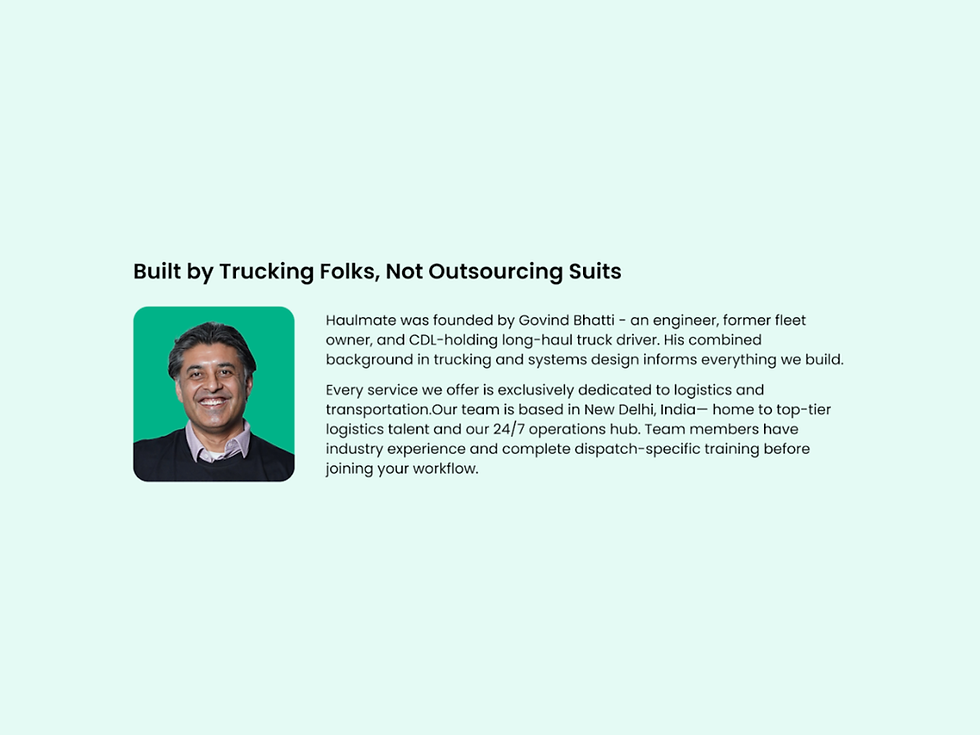
By Govind Bhatti, Founder & CEO of Haulmate
For motor carriers and 3PLs, the key to scalable staffing may be purpose-built outsourcing.
It’s a constant balancing act for motor carriers and logistics providers keeping freight moving efficiently and cost-controlled without sacrificing customer service. Nowhere is this more true than in the topsy-turvy arena of finding and keeping qualified dispatch and back-office staff.
Hiring and keeping dispatchers, billing clerks, and other operational staff has become increasingly difficult and expensive. And that cost only goes up when freight markets tighten or labor shortages make recruiting talent even harder. That’s why many over-the-road fleets and logistics companies are turning to business-process outsourcing to effectively scale dispatch and back-office staffing.
This specialized mode of outsourcing delivers a flexible, efficient, and scalable solution. And the benefits only mount when outsourcing is implemented correctly.
Here are eight steps to prepare your freight operation to successfully outsource and scale dispatching and other essential back-office tasks.
1. Determine Which Functions to Outsource
Outsourcing is not an all-or-nothing proposition. Many fleets begin by offloading time-intensive, repetitive tasks— such as data entry and check calls —before outsourcing more integrated functions like billing, customer service, carrier sales or driver management.
Start by identifying which roles:
Are hard to hire and keep staffed
Require nights and weekend coverage
Don’t directly generate revenue
Are currently being handled by overloaded internal teams
From there, define a scope of work. Make it clear which responsibilities you’re transferring and which will remain in-house.
2. Prep Your Internal Team for Change
The success of any outsourcing strategy depends on internal alignment. Operations leaders must prepare staff to collaborate with a remote or hybrid support team. This includes:
Informing current employees of the purpose and goals of outsourcing
Clarifying that outsourced support is meant to complement— not replace— their existing workload
Explaining that the intention is to allow for business growth and how responsibilities may shift over time
Tip: Operation teams that successfully outsource dispatch or back-office roles typically keep at least one internal point of contact to coordinate with their outsourcing partner.
3. Document Your Current Processes
Before an outsourcing partner can take over daily tasks, they need to understand how your operation currently runs.
That means documenting:
Communication tools and expectations
Adding loads and dispatch workflow
Track and trace updates
Customer service protocols
Hours of service management
Software systems in place
Organization and team structure
Even if your internal documentation is rough, capturing the key steps in writing will smooth onboarding and minimize disruption.
4. Standardize Your Tools and Systems
Outsourcing works best when your digital environment is standardized and accessible.
Ensure that your technology platforms are:
Cloud-based or remotely accessible
Integrated to reduce data re-entry
Equipped with clear permission controls
Many dispatch and back-office outsourcing teams work within your existing systems. If you’re still using manual spreadsheets or have limited user licenses, now is the time to upgrade.
Pro Insight: A Key Driver of Outsourcing Success
One of the most overlooked critical factors for outsourcing success is organizational readiness. Outsourcing provider Haulmate advises that businesses that involve key stakeholders early on and provide consistent internal points of contact during the onboarding process will experience faster ramp-up times, a smoother transition, and long term outsourcing success.
Bottom line: Internal communication and continuity are as important as outsourcing expertise.
5. Set Clear Service-Level Expectations
Your outsourcing partner should act as an extension of your business. To ensure that degree of alignment, agree on defined service-level expectations (SLEs):
Response-time expectations (e.g., email response time less than 15 minutes)
Escalation paths for urgent issues
Data accuracy and reporting requirements
Coverage hours (e.g., set schedules with defined shift times)
These SLEs are the foundation of any good outsourcing relationship. Put them in writing and review them periodically.
6. Budget for the Right Mix of Support
Outsourcing can cut costs, but only if you budget for it realistically. Reputable outsourcing providers in the freight space offer pricing models based on:
Hourly or monthly support rates
Full-time-equivalent staffing (for embedded, dedicated teams)
Tiered service levels (for scaling up or down)
Instead of viewing outsourcing as replacing headcount, think of it as reallocating labor. Many Haulmate clients reduce in-house payroll costs by 40% to 60%, all while gaining 24/7 support.
7. Choose a Partner That Understands Trucking
Generic call centers or overseas administrative firms may offer low outsource pricing, but they often lack the transportation and U.S. business knowledge required to manage the time-sensitive, regulation-heavy work of dispatching and load management.
By contrast, Haulmate’s solution is purpose-built for over-the-road freight carriers and logistics providers operating in the United States. That means the staff members who will work for you are:
Knowledgeable of U.S. truckload dispatching norms
Familiar with industry tools (TMS, ELDs, load boards)
Motivated and resourced for your success
Choose an outsourcing partner that understands your business. Not one that will learn it on your dime and time.
8. Treat Outsourcing as a Strategic Investment
Recognize that outsourcing dispatch and back-office roles isn’t just about saving money. It’s also about freeing your internal team to focus on strategic priorities, from growing freight volumes and improving fleet performance to strengthening customer relationships.
With a properly scoped, staffed, and managed outsourcing solution in place, businesses can:
Improve service consistency and ratings
Reduce turnover in key operational roles
Add flexibility to scale up or down with freight cycles
Maintain control over core decision-making
Get Ready to Scale Smarter
Outsourcing is not only a cost-cutting tactic, it’s a growth-enabling strategy. But the benefits only accrue when teams prepare thoughtfully and partner wisely.
At Haulmate, our outsourcing solution is purpose-built and scalable for motor carriers and logistics providers. Our industry leading solution enables over-the-road trucking and 3PL operations to boost efficiency while reducing staffing headaches.
For further insight into how our scalable outsourcing solution can help steer your freight operation to the next level, reach out to Haulmate. We’re here, like you, 24/7.



Comments